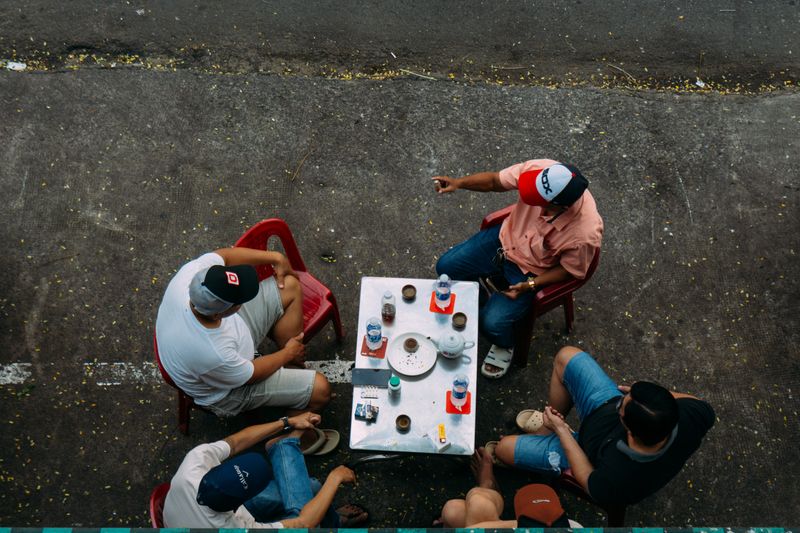
Friendship
A group of friends and a friendship are two different objects
People assume a circle is made of friendships. Often it is made of a shared setting, and the individual bonds inside it have never been tested on their own.

The options around the difference between a group and a friendship are set out side by side below, with the conditions that genuinely favour one over the other.
The difference in one place
- A group can persist for years without any two members meeting alone.
- Groups run on occasions while friendships run on individual contact.
- Losing a group and losing a friend are different losses with different repairs.
Two structures that look alike
A group is a set of people who assemble on occasions, and it has its own momentum, its own jokes and its own reasons for continuing. A friendship is a channel between two specific people that works whether or not any occasion is scheduled. A circle of eight can contain twenty-eight possible pairs and have only three or four of them actually active.
From the inside this is invisible, since everyone is present, everyone is warm and nobody counts which pairs have ever met alone. The distinction only surfaces when the group's occasions stop, which is when people discover what they actually have.
What a group provides that a pair cannot
Groups supply the sense of being placed among people, which is a different need from being known by a particular person. They also spread the conversational load, so nobody has to carry an evening and a quiet person can enjoy one without effort. The stock of shared history, the running references and the retold stories, is genuinely valuable and belongs to no single member.
After a falling-out, groups tolerate imbalance well, since somebody having a bad year can simply attend without being required to contribute much. None of this is lesser than one-to-one friendship; it is a different provision with different failure modes.
What a pair provides that a group cannot
Very little of consequence gets said at a table of eight, because the format rewards performance and punishes anything that slows the room. Being known in detail requires somebody to have the time and attention to follow your specific situation over months.
The unglamorous truth is that difficulty in particular needs a pair, since a group will absorb a hint and move on without anyone intending to. Pairs also survive the group, which is the practical argument for building a few of them while the group is still meeting. The healthiest arrangement is usually a group with several strong pairs inside it, which is more robust than either alone.
How groups actually end
Most groups do not fracture; they thin, as one person moves, another has a child and a third quietly stops replying to the chat. Because groups depend on a critical mass, losing two members can make the remaining occasions feel wrong enough to stop happening. The person who organised the occasions often stops around the same time, and no successor emerges because nobody realises the role existed.
Members experience this as everyone getting busy, which is true and does not explain why the busyness was not a problem before.
The group ends without a decision, and afterwards each person keeps whichever individual friendships had already been established.
Losing a group is a specific kind of loss
Losing a circle removes a place to be rather than a person, and that produces a loneliness that having other friends does not fix. It also removes a version of yourself, since the person you are in a long-standing group is often more relaxed than the one anywhere else. People underestimate it because there is no name for it, no event marking it and no obvious thing to grieve.
Rebuilding takes considerably longer than replacing one friendship, since a group requires several people to want the same thing at the same time. The realistic route is usually to join an existing group rather than to construct a new one from your own scattered friends.
If a relationship has stopped feeling safe rather than merely difficult, that needs more than an article.
Building pairs inside a circle
Choose two or three people in your group and arrange something with each of them individually over the next few months. Expect the first one-to-one meeting to be slightly odd, because you are both used to a format with more people in it. Do not explain what you are doing, since narrating it makes an ordinary invitation into a statement about the group.
After a falling-out, notice which conversations change character once the audience is gone, as that is where the real friendship is. If the group ends later, you will find you have kept the parts of it that were actually yours.
Side by side
| Consideration | What it means in practice |
|---|---|
| Two structures that look alike | A group can persist for years without any two members meeting alone. |
| What a group provides that a pair cannot | Groups run on occasions while friendships run on individual contact. |
| What a pair provides that a group cannot | Losing a group and losing a friend are different losses with different repairs. |
The takeaway
Count how many people in your circle you have ever met alone, and treat that number as the real size of it.
Nobody keeps everyone. Choose the few and be serious about them.
Questions readers ask
Can a group survive if nobody meets one to one?
It can, for as long as the occasions keep happening. It simply has no fallback, so the first serious interruption tends to end it.
I have friends but no group. Is that a problem?
It is a different provision, not a deficiency. If you miss the feeling of being among people, look for a recurring activity rather than more individual friendships.